How Retinoids and Tretinoin Rebuild Your Skin’s Collagen
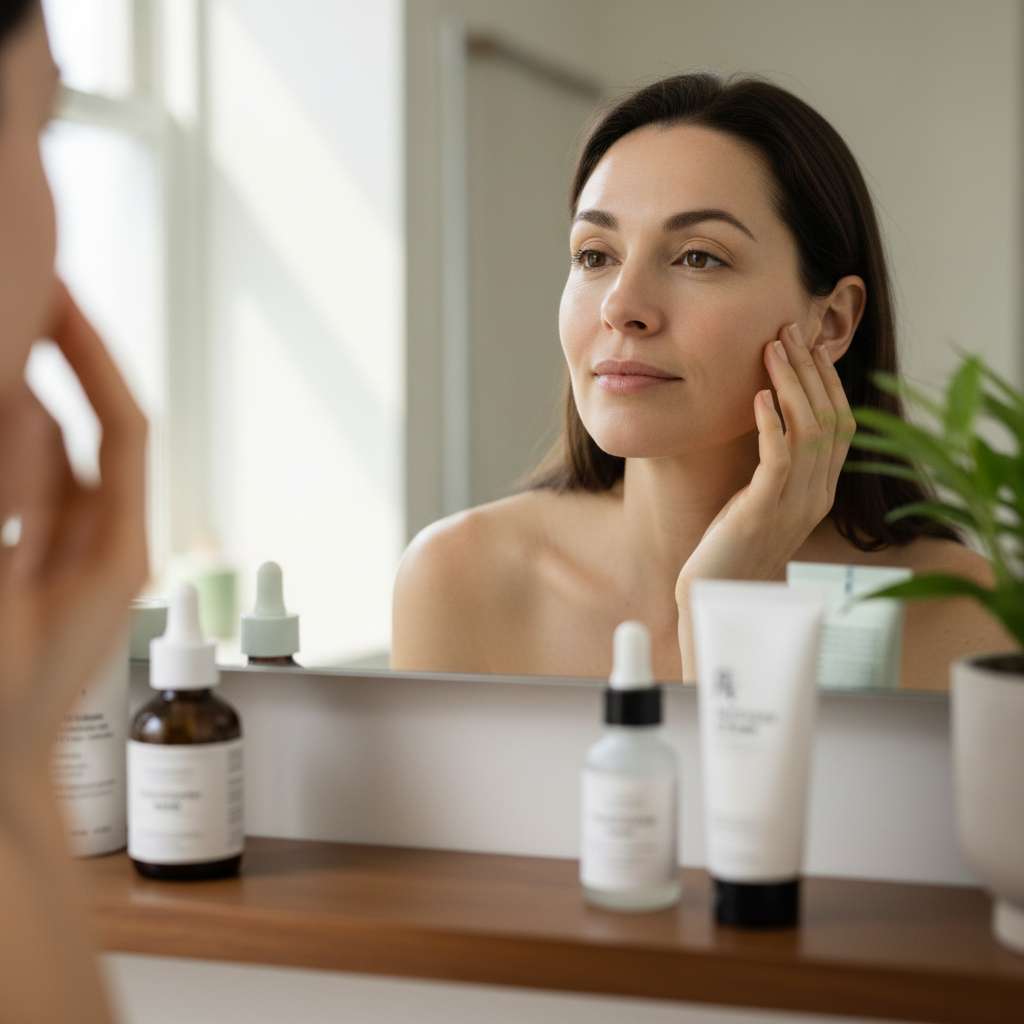
Retinoids rebuild collagen by signalling skin cells called fibroblasts to make fresh type I and III collagen, while blocking the enzymes that tear it down. Tretinoin, the prescription form, does this most powerfully. Over three to six months, that quiet biochemistry shows up as firmer, smoother, visibly denser skin.
What retinoids actually do to your collagen
Retinoids work on collagen in two directions at once. They tell your fibroblasts to build new collagen, and they switch off the enzymes that break the old collagen down. That double action is why they outperform almost every other anti-age ingredient on the shelf.
The build-up side comes from upregulated type I procollagen, the raw material your skin weaves into its support scaffold. The protection side comes from blocking matrix metalloproteinases, or MMPs, the demolition enzymes that ramp up with sun exposure and age. Quiet the demolition crew, fund the builders, and the scaffold thickens.
You won’t feel any of this happening. The change lives in the dermis, below what your fingertips can sense. You simply notice, weeks later, that skin bounces back faster and lines sit shallower.
Why your skin loses collagen with age
Collagen decline is mostly a numbers problem. From your mid-twenties, natural collagen production starts dropping by roughly one percent a year, and your fibroblasts grow lazier at replacing what’s lost. The scaffold thins, and the skin above it loses its spring.
Sunlight accelerates the whole process. Ultraviolet light triggers a protein called activator protein-1, which floods the skin with collagen-chewing MMPs. This is photoaging, and it accounts for the majority of visible facial aging. Genetics set the pace, but daylight presses the gas pedal.
Hormonal shifts add another layer, especially around menopause, when collagen can fall sharply in a short window. The good news is simple. Fibroblasts stay responsive. Give them the right signal and they get back to work.
Tretinoin and retinol are not the same molecule
Tretinoin is the active form your skin can use immediately, while retinol is a milder precursor that has to be converted first. That single difference drives everything else about how the two behave on your face.
Retinol is sold over the counter. Your skin converts it through two chemical steps into retinoic acid, the form receptors actually read. Tretinoin skips the queue. It is retinoic acid already, prescription-only, and estimated at around twenty times the potency of retinol. More power, more results, and more potential for irritation if you rush.
Which should you reach for? A well-formulated retinol, used consistently, genuinely builds collagen over time and suits beginners and reactive skin. Tretinoin delivers faster, deeper change for photoaging and stubborn texture. In our experience, the best retinoid is the one you can actually tolerate four nights a week.
How tretinoin switches collagen production back on
Tretinoin restores collagen formation even in skin that already shows sun damage. This was demonstrated decades ago in controlled research, including a landmark New England Journal of Medicine study on photodamaged human skin, and the findings have held up ever since.
The mechanism is elegant. Applied before UV exposure, tretinoin blocks that AP-1 signal, so fewer collagen-degrading enzymes get made. At the same time, it pushes fibroblasts to lay down fresh type I procollagen. Cell turnover speeds up, the epidermis renews, and the dermis quietly refills.
Think of it as renovating a building while reinforcing the foundation underneath. You see the new paint on the surface. The structural work matters more.
The difference between treating and banking collagen
You can use retinoids to repair lost collagen or to protect the collagen you still have. Dermatologists call the second approach collagen banking, and it changes when you start rather than what you apply.
Banking means starting earlier, often in your late twenties or early thirties, to slow the annual decline before fine lines set in. Treating means reversing visible photoaging that has already arrived. The same molecule serves both goals. The mindset is what shifts.
A classic mistake we see is waiting for deep wrinkles before acting. Prevention is cheaper than repair, on your face as much as your roof.
What the retinoid purge really means
The so-called retinoid purge is your skin speeding up, not breaking down. As turnover accelerates, clogged pores and hidden comedones surface faster than usual, which can look like a sudden flare in the first few weeks.
It usually begins within the first two weeks and settles within two to six. Not everyone purges, and a steady, low-frequency start keeps it mild. Redness, flaking, and tightness often join the party early on. These fade as your skin adapts.
Here is a typical picture. A reader starts tretinoin nightly, panics at week two when small bumps appear, and quits. Had they dropped to twice weekly and kept going, the bumps would have cleared by week six and the real benefits would have followed. Push through, don’t bail out.
How long before you see firmer skin
Collagen results take patience, not weeks. Most people need three to six months of consistent use before firmness and texture clearly improve, and full collagen remodelling can keep developing for up to a year.
Surface perks arrive sooner. Glow and smoothness often show within four to eight weeks, because those come from faster epidermal turnover. The deeper dermal rebuild simply runs on a slower clock. Consistency beats intensity every single time.
Mark a calendar. Take a photo on day one. Memory is a poor judge of slow change, and your own face is the hardest to assess honestly.
How to start a retinoid without wrecking your barrier
Start low and go slow, every dermatologist says it for a reason. A pea-sized amount for the whole face, two to three nights a week, gives your skin room to adapt without triggering a raw, peeling mess.
Most people reach full tolerance somewhere between weeks eight and twelve. Buffering with moisturiser before or after application softens the early sting without blocking results. We most often see beginners fail by using too much, too soon, on too-clean, still-damp skin.
Before you build your routine, keep these starter rules in view:
- Apply to dry skin, never damp, to limit irritation.
- Use a true pea-sized dose for the entire face.
- Begin two nights a week, then increase as your skin allows.
- Pair every retinoid night with a richer moisturiser.
- Pause for a night or two if you flake, don’t quit.
Why sunscreen makes or breaks your results
Sunscreen is not optional with a retinoid, it is half the treatment. Retinoids make skin more sun-sensitive, and unprotected UV exposure reactivates the very enzymes you are trying to silence. Skip SPF and you fund the demolition crew you just paid to fire.
Use a broad-spectrum SPF 30 or higher every morning, rain or shine. This protects your fresh collagen and keeps irritation lower. Many users apply their retinoid faithfully at night, then undo the gains by noon without realising it.
One honest sentence settles it. No sunscreen, no point.
Where peptides fit alongside your retinoid
Peptides complement retinoids rather than compete with them. Where a retinoid commands fibroblasts to build, signal peptides nudge the same collagen pathways from a different angle, and they tend to be gentle enough to layer on nights you skip your retinoid.
This pairing suits sensitive or maturing skin that can’t tolerate nightly tretinoin. If you want the mechanics, our guide on how peptides work in skincare breaks down the signalling, and a collagen-focused formula like Matrixyl-3000 serum shows the approach in practice.
Layering is straightforward. Retinoid some nights, peptides on the others, sunscreen every morning. You get steady collagen support without overwhelming your barrier.
FAQ
Can retinol build collagen as well as tretinoin?
Yes, retinol builds collagen, just more slowly and gently than tretinoin. Studies show both raise collagen production, but tretinoin acts faster and stronger because it skips the conversion step. For sensitive skin or beginners, well-formulated retinol used consistently for several months is a legitimate, lower-irritation route to firmer skin.
At what age should I start using a retinoid?
Your late twenties to early thirties is the sweet spot for prevention. That is when natural collagen starts declining by roughly one percent yearly, so starting early helps you bank collagen before deep lines form. There is no upper limit, though. Photoaged skin in your fifties and beyond still responds well to retinoids.
Is it normal for skin to look worse before it improves?
For many people, yes, especially in the first few weeks. The retinoid purge, dryness, and flaking reflect accelerated cell turnover, not damage. It typically settles within two to six weeks. Reduce frequency and buffer with moisturiser rather than stopping, and the temporary roughness gives way to smoother skin.
Can I use retinoids and peptides together?
Yes, retinoids and peptides pair well and target collagen through different routes. Many people alternate them, using a retinoid on some nights and a peptide serum on others to limit irritation. Peptides are gentle enough for daily use, which makes them a useful companion on the nights you rest from your retinoid.
How much retinoid should I apply each time?
A single pea-sized amount covers your whole face. More product does not mean faster collagen, it mostly means more redness and peeling. Spread that small dose thinly across dry skin, then follow with moisturiser. Overapplication is the most common reason beginners abandon retinoids before they ever see results.